
Materials
Marble Countertops: Will You Regret Them?
Marble is the countertop people fall for first and worry about most. It will etch, and no sealer stops that. Whether you end up loving it or regretting it comes down to the finish, the room, and knowing what you are signing up for before the slab is cut.
Marble is the countertop people fall in love with first and worry about most. Somebody always has a story about a friend who put in a white marble island and spent the next year chasing lemon marks. Somebody else has lived with marble for twenty years and would never have anything else.
Both are telling the truth. Marble does mark, and nothing you buy will stop it. Whether that becomes a regret or the reason you love it depends almost entirely on decisions made before the slab is cut: the finish, the room, the stone, and whether you knew what you were signing up for.
What marble actually is
Marble is limestone that heat and pressure have recrystallised over geological time. That history is where its beauty comes from, the soft white grounds and the veining that runs through them, and it is also where every one of its habits comes from. Marble is made mostly of calcite, a mineral that is relatively soft and that reacts with acid.
Everything else in this article follows from those two facts. Softness means it scratches and chips more readily than granite or quartzite. Reacting with acid means it etches. Neither is a defect in a particular slab. It is simply what marble is.
Etching and staining are not the same thing
This is the single most useful thing to understand about marble, and most of the regret stories come from confusing the two.
- A stain is something that soaks into the stone and changes its colour: oil, coffee, red wine left sitting. Sealing is what prevents it, by slowing how fast liquid gets in.
- An etch is a chemical reaction on the surface. Lemon juice, vinegar, wine, tomato sauce and some cleaners dissolve a microscopic layer of calcite and leave a dull, slightly rough mark. It is not a colour change; it is a change in texture.
Sealer does nothing to stop etching, because the acid attacks the stone itself rather than soaking into it. Fine Homebuilding's guide to stone countertops (opens in a new tab) calls marble one of the most reactive stones there is, and is plain that frequent sealing helps but will not prevent the problem. Anybody who tells you a sealer makes marble etch-proof is selling something.
What marble looks like after a year of real cooking
The most useful evidence is not a lab result but a kitchen. In a year-long account published by the Natural Stone Institute (opens in a new tab), a homeowner with a honed, sealed marble kitchen reported no stains at all, including a coffee ring left overnight and spilled marinara. What she did get was etching, concentrated where she prepares food, plus one spot by the sink where water pooled along a seam and yellowed the stone until it was drawn out with a poultice.
Her conclusion was that she would choose marble again, and that the etching reads as patina rather than damage. That is the honest shape of living with marble: stains are very manageable on a well-sealed slab, etching is not optional, and how you feel about the etching decides everything.
Honed or polished: the decision that matters most
On a polished slab, an etch shows as a dull patch on a glossy surface. You see it as soon as light hits the counter at a low angle, and on a polished kitchen island light hits it at a low angle all day.
A honed finish is already matte, so an etch has much less to contrast with. It does not prevent etching; it disguises it. That is why marble kitchens are so often honed, and why both the homeowner above and Fine Homebuilding point to honed for anyone who will actually cook on it. The trade-off is that a honed surface is slightly more open, so it is worth being diligent about sealing and about wiping up oil.
- Choose polished if the marble is somewhere it will rarely meet acid, or if you want the deepest colour and are happy to live with visible etch marks.
- Choose honed for a working kitchen, especially on an island or prep area.
- Lighter marbles hide etching and small impact marks better than dark ones, because an etch reads as a pale, dull mark.
Scratches, chips and edges
Marble is noticeably softer than granite or quartzite. A ceramic pot dragged across it can scratch it, and a heavy jar dropped on it can leave a small white bruise where the crystals are crushed. Fine Homebuilding describes exactly this: a dime-sized white spot from a drop.
The edge matters more than people expect. A sharp, square edge on marble will chip the first time something knocks it. A softly eased or rounded edge is far more forgiving, and on a busy island it is the practical choice. It is a small detail at templating that saves a lot of irritation later.
Heat
Marble has no resin in it, so it does not scorch the way engineered quartz can. That does not make it a trivet. A very hot pan on a cold slab is a sudden temperature change in one spot, and grease and burnt-on residue are their own problem on a porous surface. Use a trivet; it costs nothing.
Marble vs quartz
This is the comparison most people are really making, because engineered quartz can be made to look a lot like marble. The honest version:
- Etching: quartz does not etch. Marble does, always.
- Staining: quartz is non-porous and never needs sealing. Marble needs sealing and wiping up after.
- Scratching: quartz is much harder to scratch in everyday use.
- Heat: marble tolerates heat better, because quartz contains resin that sustained heat can mark.
- Look: quartz repeats its pattern predictably; marble is one block's geology and no two slabs are the same. A shaped or mitred quartz edge can also read plainer than the face, while marble is the same stone all the way through.
If you want the marble look with as little care as possible, a marble-look quartz is an honest choice and nothing to apologise for. If what you love is real stone, its depth and the way it ages, quartz will never quite replace it. Decide which of those you are actually buying.
Marble vs quartzite
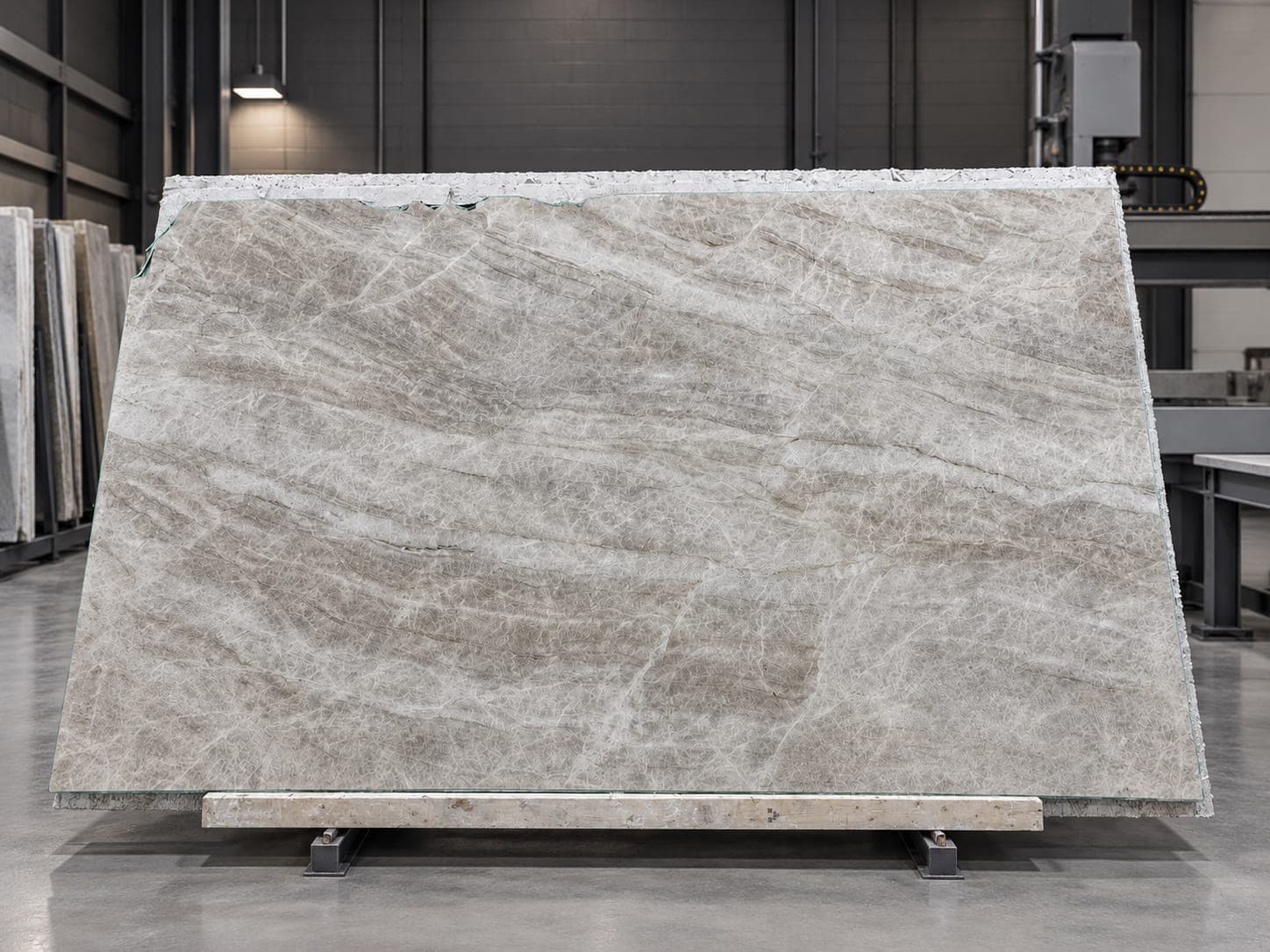
For people who love marble but cannot accept etching, quartzite is usually the answer. It is a natural stone with marble-like movement, but it is silicate rather than calcite, so ordinary kitchen acids do not etch it, and it is much harder. Our guide to quartzite countertops explains the difference, and Taj Mahal quartzite is the one most often chosen as a warm, soft alternative to marble.
One warning runs the other way. Some stones sold as quartzite are actually marble or dolomitic marble, and they will etch. If the reason you are choosing quartzite is to avoid etching, test the actual slab with a few drops of lemon juice before you commit.
Choosing a marble slab
- See the full slab. Marble's veining changes dramatically across a block, and a small sample tells you almost nothing about an island.
- Ask what the stone is and where it was quarried. Marbles vary in density, and dolomitic marbles generally etch more slowly than calcite ones, which is worth knowing for a kitchen.
- Look for fissures and filled areas. Natural stone has them and most are harmless, but they should be placed deliberately, away from sink cut-outs and edges.
- For a large kitchen, buy every slab from the same bundle so colour and veining carry across the room.
- If the veining is dramatic, plan where it lands across seams and on any waterfall end before anything is cut.
Where marble works best
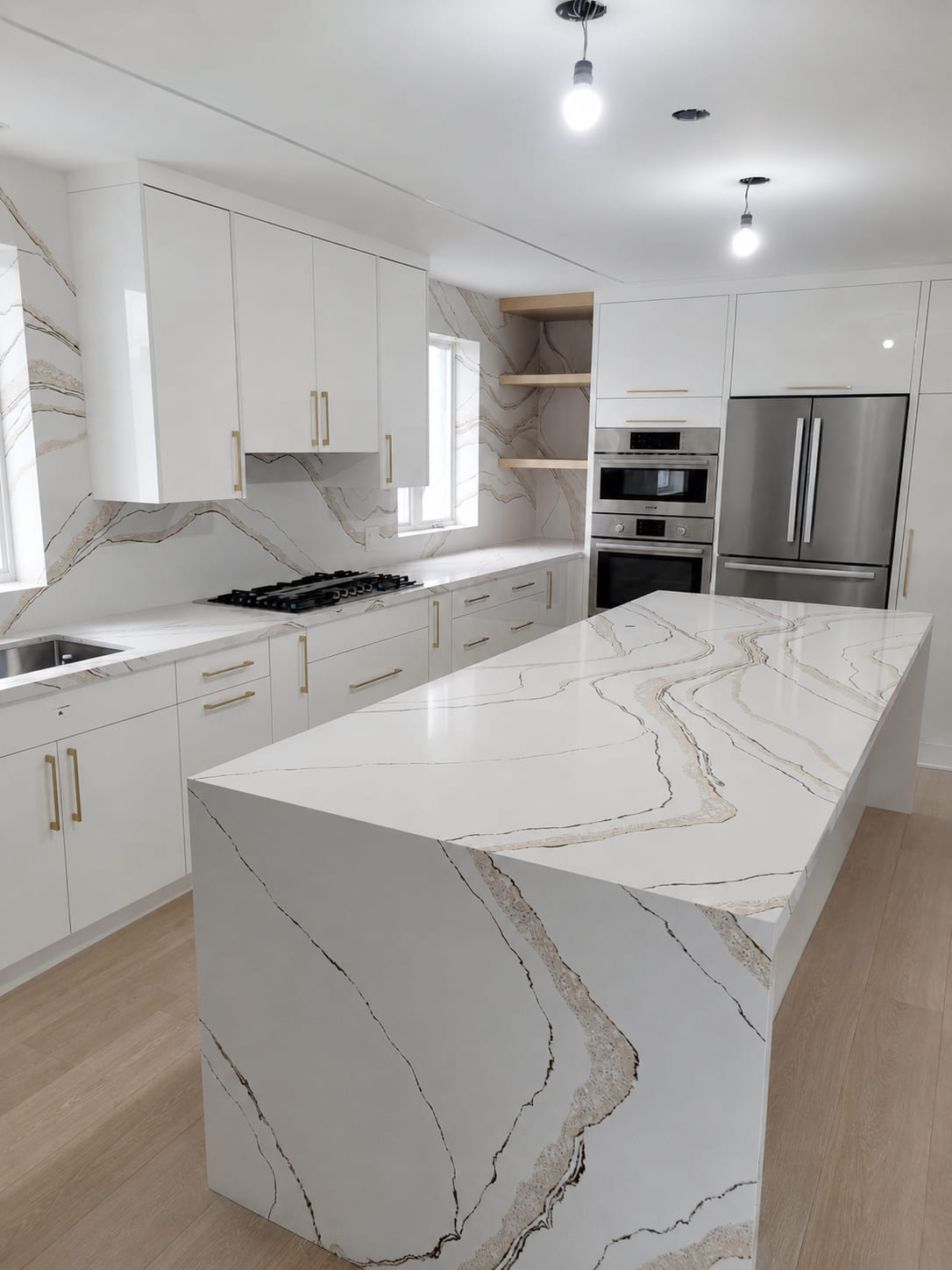
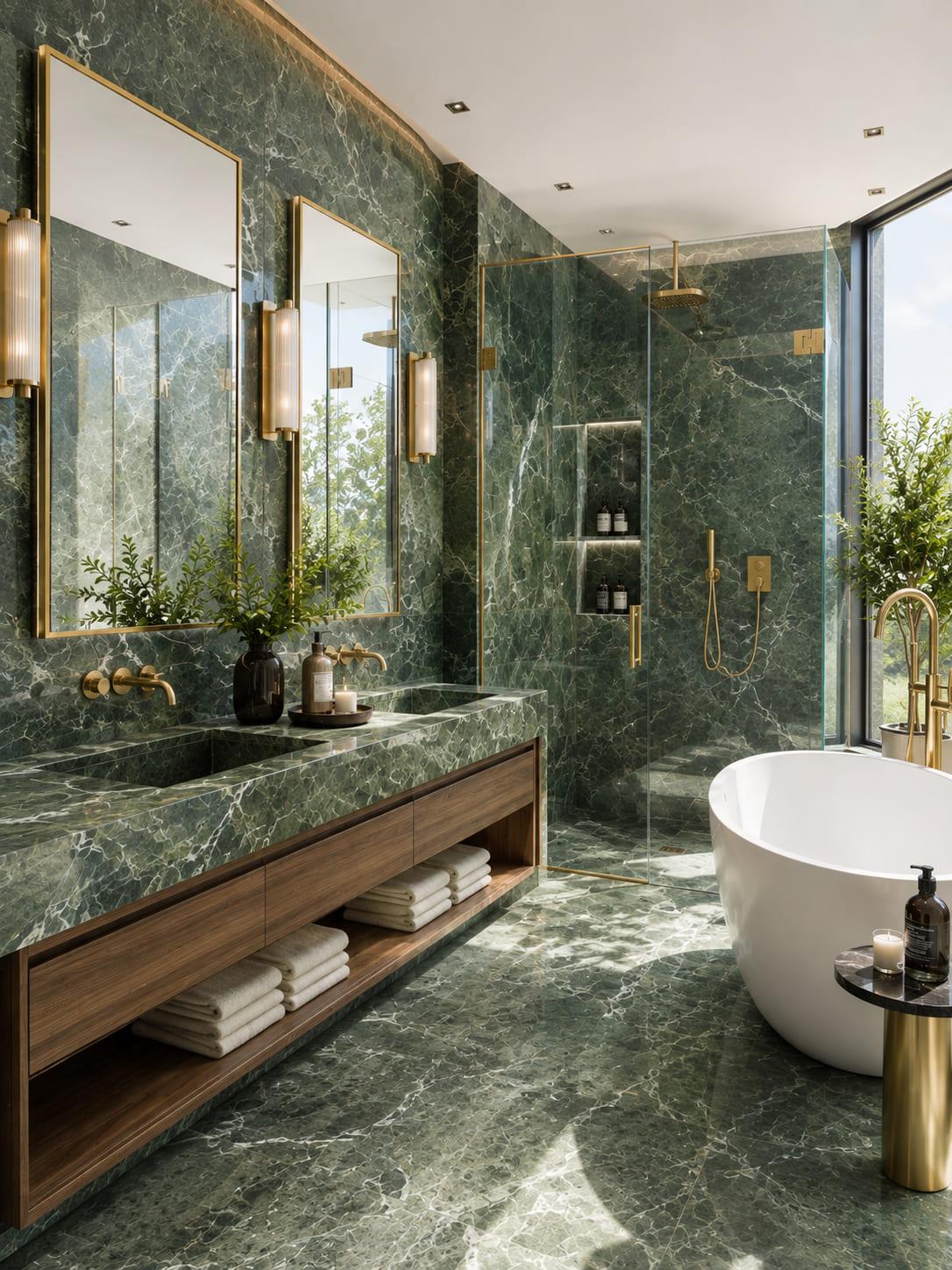
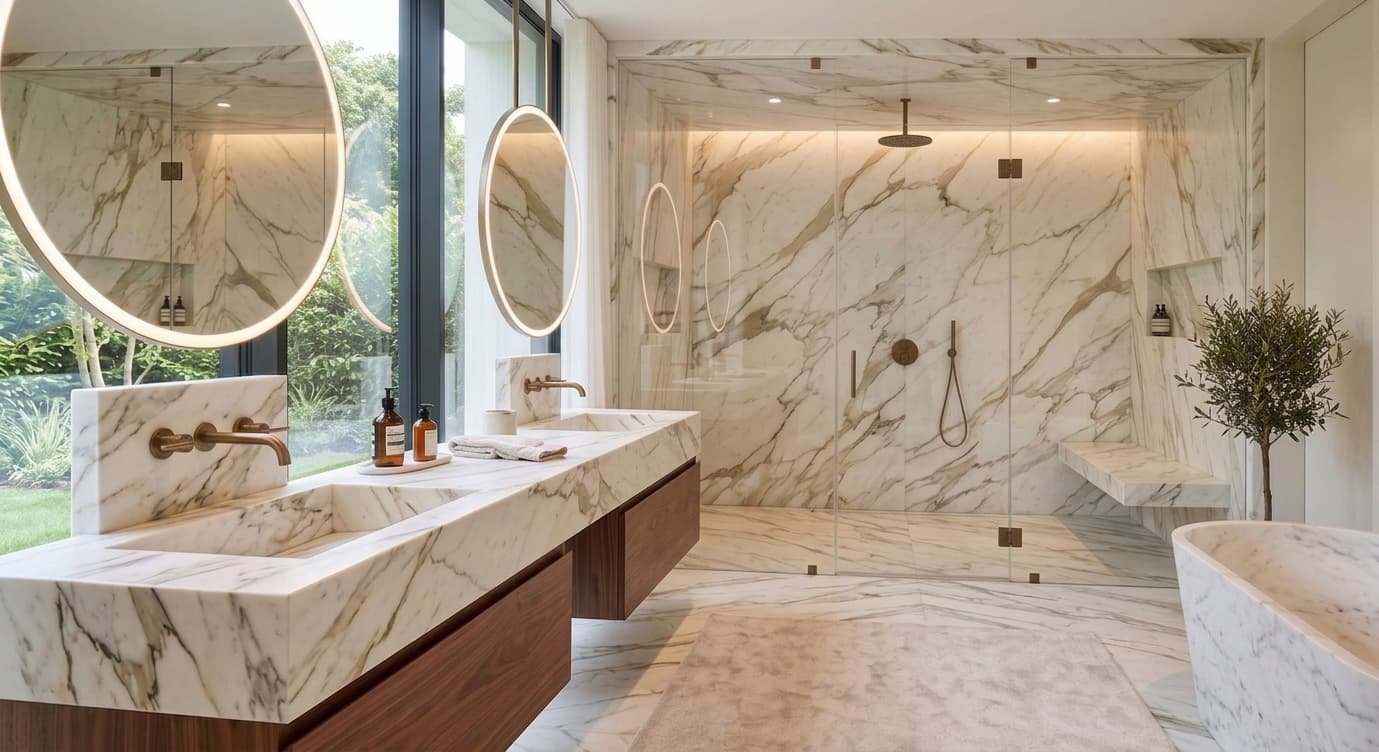
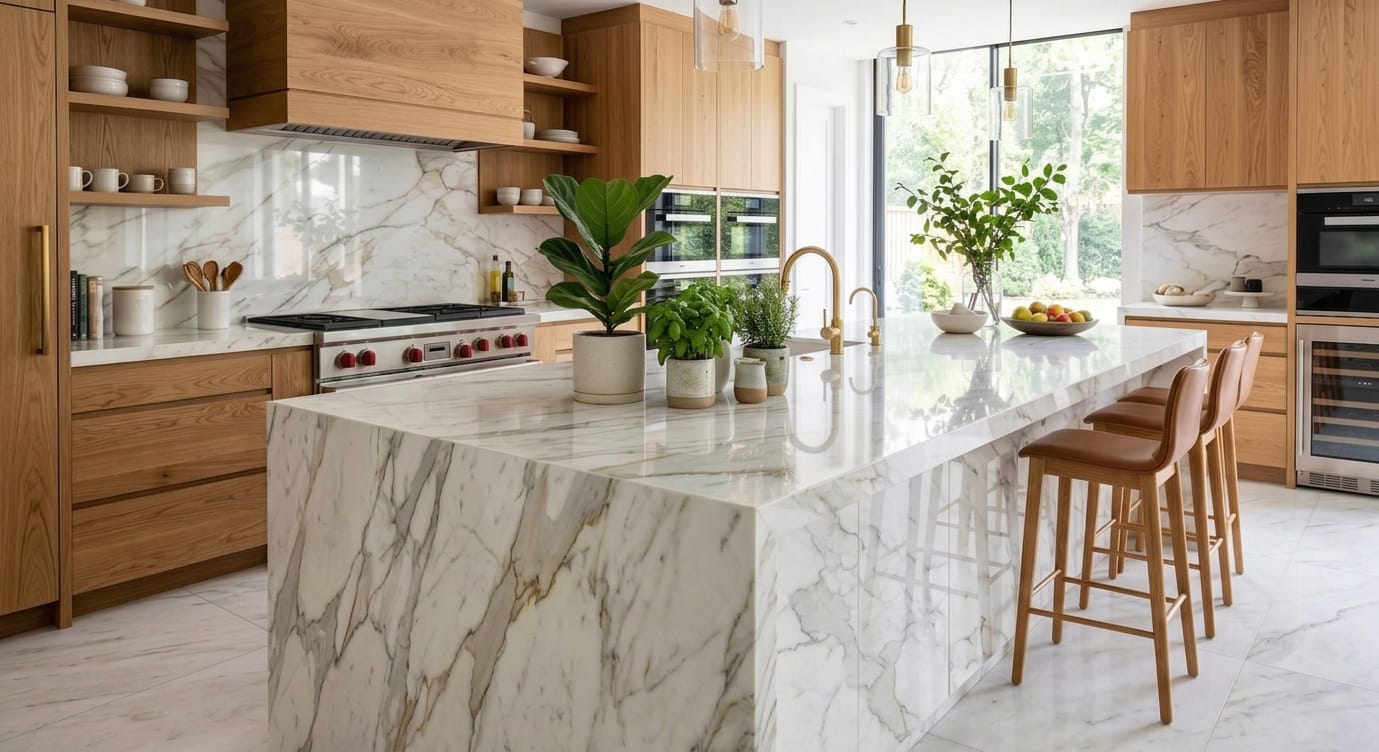
Marble is at its best where it is admired more than it is worked: bathroom vanity tops, shower walls, fireplace surrounds and feature walls, where a pair of bookmatched slabs can be opened like a book across the centre. In a kitchen it is a classic choice for a baking station, because the surface stays cool, and for an island where the owner genuinely likes the idea of patina.
A common and very sensible compromise is to split the kitchen: marble on the island, where it is the centrepiece, and quartz or quartzite on the perimeter counters around the sink and range, where most of the acid, oil and hard work happens. You get the stone you love where it is seen, and an easy surface where it is used.
Living with marble day to day
- 01Wipe up acids quickly: lemon, vinegar, wine, tomato, soft drinks. Speed reduces how deep an etch goes.
- 02Clean with warm water and a pH-neutral stone cleaner or mild dish soap. Avoid vinegar, bleach and general-purpose sprays that are acidic or harsh.
- 03Use boards for cutting and trivets for heat, and lift heavy pots rather than sliding them.
- 04Test the seal now and then: a few drops of water left for a few minutes. If the stone darkens, it is time to reseal.
- 05Light etching on honed marble can often be blended with an etch remover. Deeper etching, or etching on polished marble, is a job for a professional who can re-hone or repolish the area.
Our natural stone care guide goes into cleaning and sealing in more detail.
So, will you regret it?
You probably will if you expect marble to stay exactly as it looked on installation day, if the counter will take daily cooking with lemons and wine, and if every dull mark will bother you. In that kitchen, quartzite or a good marble-look quartz is the better decision, and there is no shame in it.
You probably will not if you choose a honed finish, put it where it suits, and accept that it will look lived in, the way marble in old European kitchens and bakeries has for centuries. If you are weighing marble against quartz or quartzite for a specific room, that is a conversation worth having over real slabs. We template, cut and install marble in our North York shop for kitchens, vanities and feature walls across Toronto and the GTA; our kitchen countertops and islands page explains how a project runs.
FAQs
Common questions.
Is marble a good choice for kitchen countertops?
It can be, if you choose it knowingly. Marble will etch from acids like lemon, vinegar and wine, and no sealer prevents that. A honed finish disguises etching well, and many owners treat the marks as patina. If you want a surface that stays unchanged, quartzite or quartz is a better fit.
What is the difference between etching and staining on marble?
A stain is something absorbed into the stone that changes its colour, such as oil or coffee, and sealing helps prevent it. An etch is a dull mark where acid has reacted with the calcite in the marble. Sealing does not prevent etching.
Is honed or polished marble better for a kitchen?
Honed, for most kitchens. An etch on polished marble shows as a dull patch on a glossy surface, while a honed finish is already matte, so etching is far less visible. Honed marble should be kept well sealed and oil wiped up promptly.
Is marble or quartz better?
Quartz is easier: it does not etch, never needs sealing and resists scratching. Marble is real stone with unique veining, handles heat better than quartz, and ages with a patina some people love. Choose quartz for low maintenance and marble for the material itself.
How often does marble need to be sealed?
It depends on the stone and the sealer, so test rather than follow a calendar. Leave a few drops of water on the surface for a few minutes; if the stone darkens, it is absorbing and is ready to be resealed.
Can etching on marble be repaired?
Light etching, especially on honed marble, can often be blended with an etch remover. Deeper etching or etching on polished marble usually needs a stone professional to re-hone or repolish the area.
Related Services
Where this applies.
Related Reading
More from the Journal.
Start Your Project
Ready to plan your own project?
Request an estimate or book an on-site laser measurement — our team will respond as soon as possible.