
Materials
Taj Mahal Quartzite: Is It Worth the Hype?
Taj Mahal looks like a soft, warm marble and behaves like real quartzite. It is also the most copied and mis-sold stone in the yard. Here is what it is, where it disappoints, and how to choose a slab you will still like in ten years.
Taj Mahal is the stone people bring photographs of. It turns up in saved design boards more often than any other countertop, usually with a note that says something like "this, but it can't be fussy." That is the whole appeal in one line: it looks like a soft, warm marble, and it behaves like something much tougher.
It is also the stone most often copied, renamed and mis-sold. Getting a good one is less about deciding you want Taj Mahal and more about knowing what to check once you have.
What Taj Mahal quartzite actually is
Despite the name, it has nothing to do with India. Taj Mahal is a quartzite quarried in the state of Ceará in northeastern Brazil; the name is a trade name, borrowed for the marble-like softness of the stone rather than for where it comes from. According to the stone-industry publication Litos (opens in a new tab), it comes from a handful of quarries rather than one, and the same family of material is also sold as Perla Venata, Perla Santana, Matira and Naica.
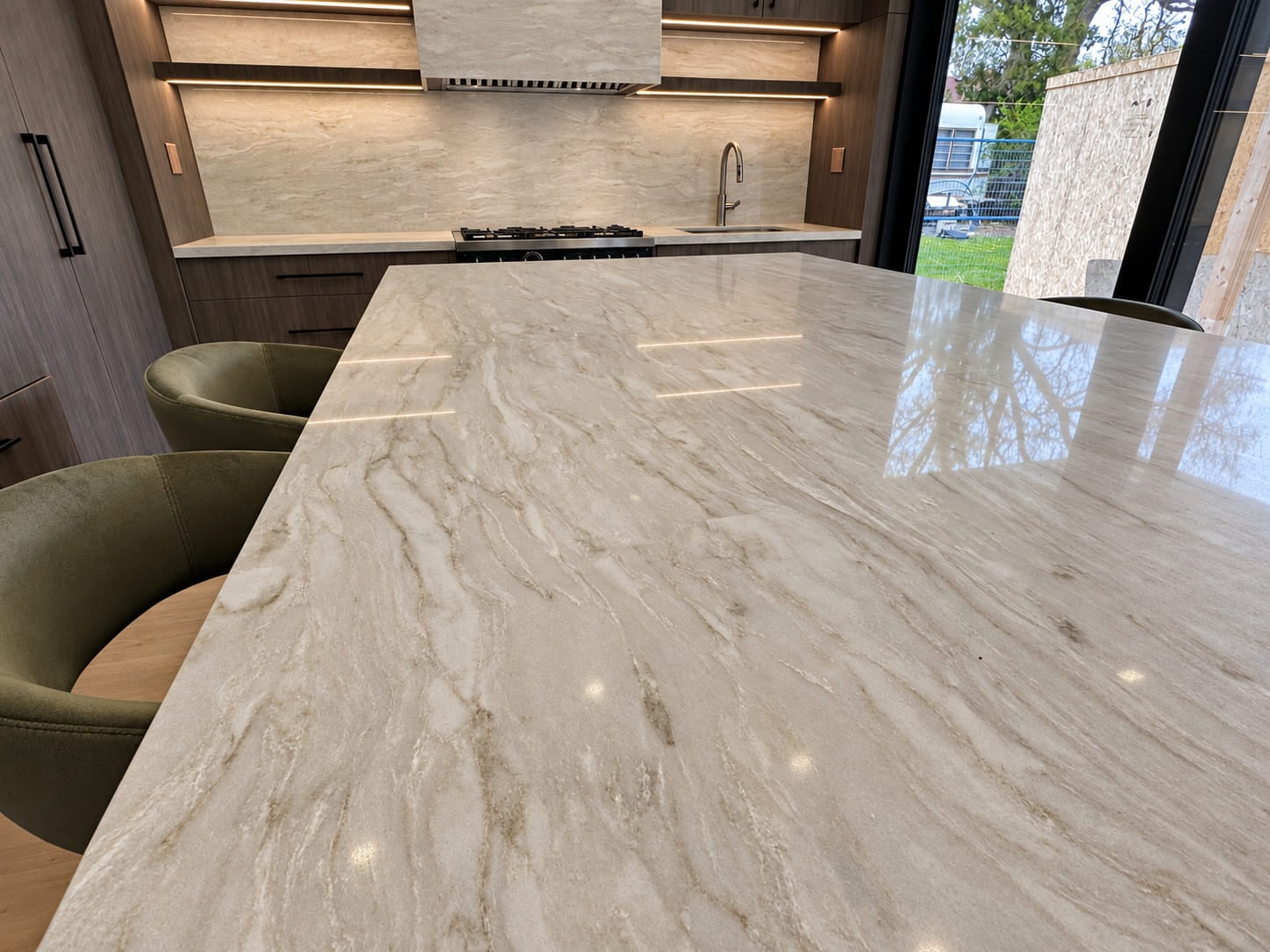
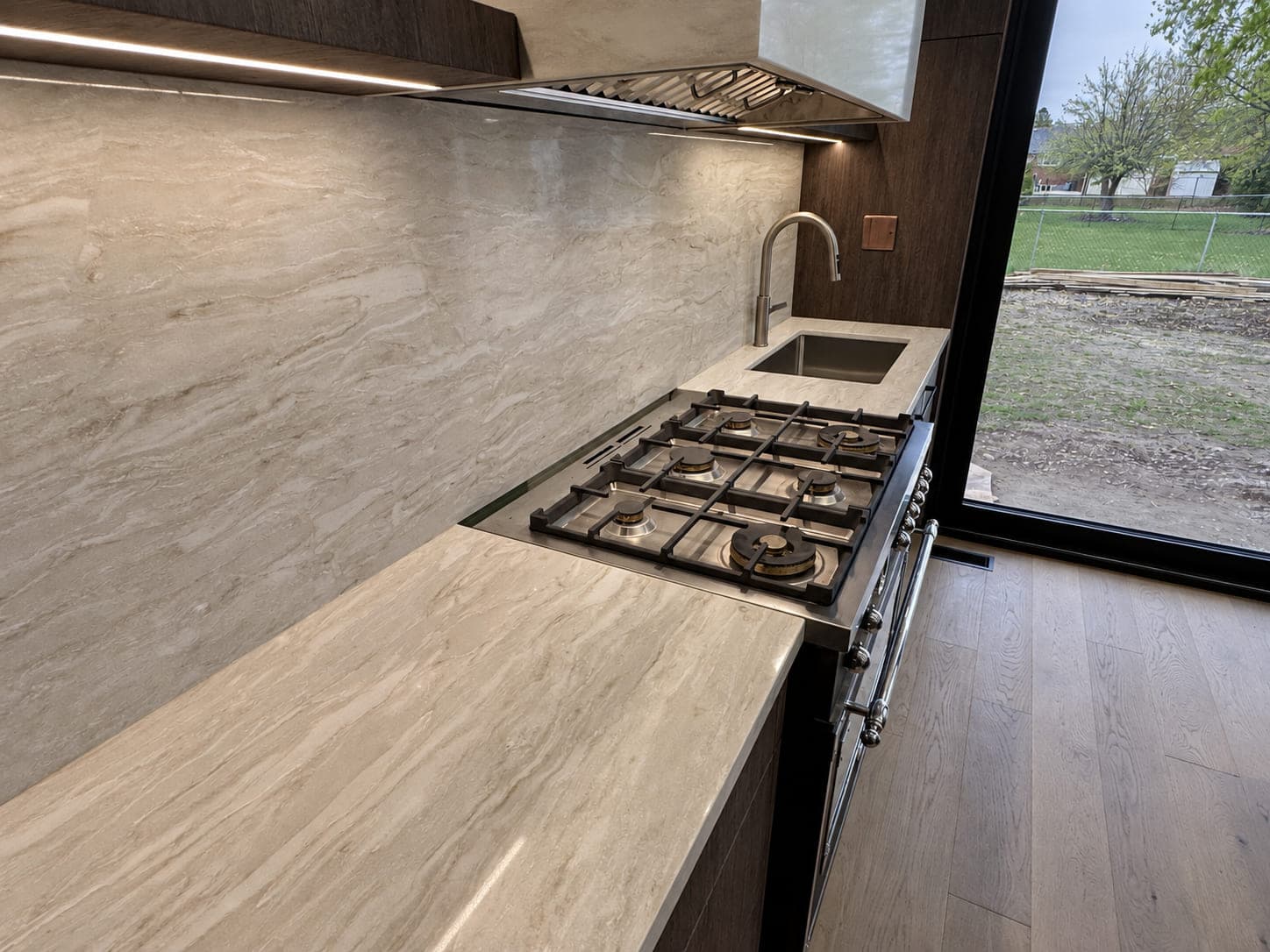
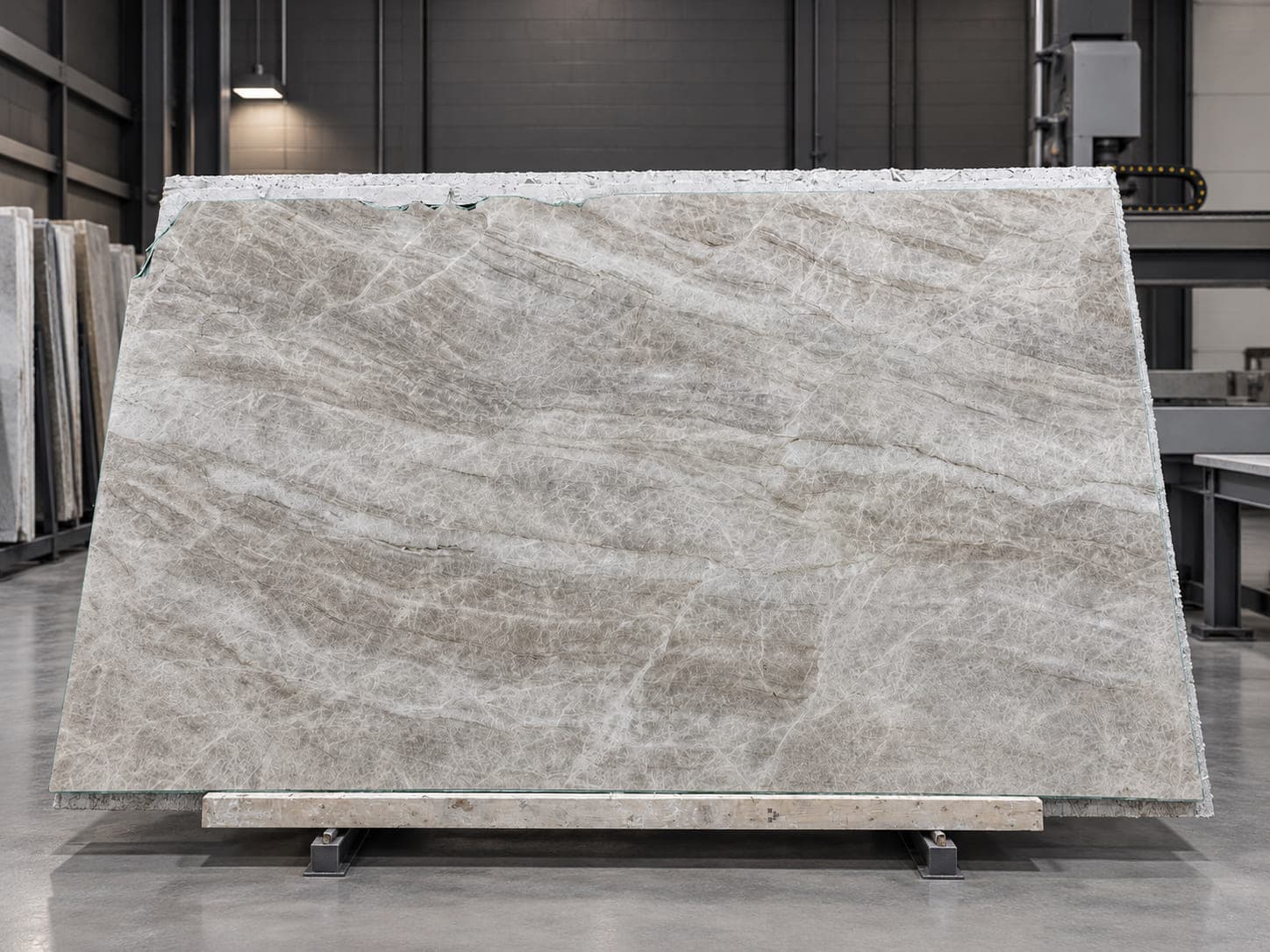
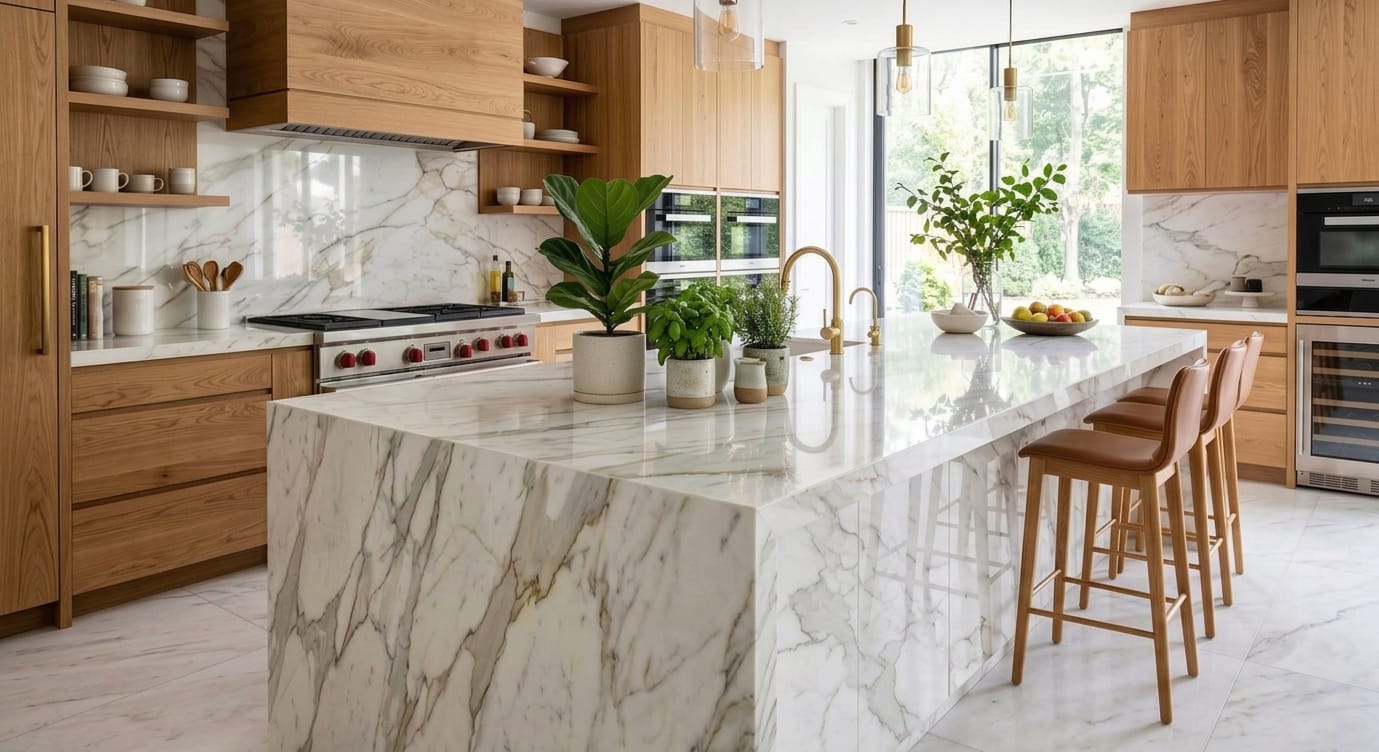
Visually it is a warm white to cream background with soft, flowing veins in taupe, beige and occasionally gold. The movement is gentle rather than dramatic, which is why it reads as calm in a room. It is a natural stone, so no two slabs are the same, and slabs from different quarries or different parts of the same block can vary noticeably in warmth and in how much veining they carry.
Geologically it is genuine quartzite: sandstone that heat and pressure have fused into a single dense rock. If you want the background on quartzite as a family, how it differs from engineered quartz and why it does not etch like marble, our guide to quartzite countertops covers it. This piece is about Taj Mahal specifically.
Why it became the stone everyone asks for
For years, the choice for anyone who loved marble was uncomfortable. Marble is beautiful and it etches: lemon juice, wine and vinegar leave dull marks on a polished surface that no sealer prevents. Taj Mahal gives most of that look without the problem. It is silicate rather than calcite, so ordinary kitchen acids do not etch it, and at around 7 on the Mohs scale it is harder than a knife blade.
The timing helped too. Kitchens have moved away from stark white and grey toward warmer wood, cream and taupe, and Taj Mahal sits naturally in that palette. It is one of the few stones that looks right against both white oak and dark walnut cabinetry.
Taj Mahal quartzite vs "Taj Mahal quartz"
This is the single most important distinction in this article, because the two names are a letter apart and the products are completely different. Several engineered quartz makers sell designs with Taj Mahal in the name, or designed to imitate it. Those are manufactured slabs of crushed quartz bound with resin. They can be very good products. They are not the stone.
- Heat: real quartzite tolerates heat far better. Engineered quartz contains resin, and sustained heat from a pan can scorch or discolour it.
- Sealing: engineered quartz is non-porous and never needs it. Taj Mahal is natural stone and should be tested, and sealed when it absorbs.
- Pattern: on many engineered designs the veining is concentrated on the face, so a shaped or mitred edge can read plainer than the top. Natural Taj Mahal is the same stone all the way through.
- Repeatability: engineered quartz looks the same from slab to slab, which makes large kitchens easier to plan. Natural Taj Mahal varies, which is the point for some people and the problem for others.
Neither is the better choice in the abstract. If what you want is the look with no upkeep at all, an engineered version is an honest choice. If you want the real thing, make sure the quote says quartzite, names the stone, and that you have seen the actual slabs.
The downsides nobody puts on the sample card
Taj Mahal is an excellent kitchen stone, but it is not maintenance-free and it is not indestructible. These are the trade-offs worth knowing before you commit.
- It is still porous. Taj Mahal is one of the denser quartzites, but dense is not sealed. Oil left sitting on an unsealed surface can darken it, and on a pale stone that shows.
- Edges can chip. Hardness is not toughness. A heavy pot dropped on a sharp corner can chip any hard stone, which is why a slightly eased or rounded edge is more practical than a knife-crisp one in a busy kitchen.
- It costs more to fabricate. A very hard stone cuts more slowly and wears tooling faster than marble or engineered quartz, and that shop time shows up in the quote.
- The undertone is warm. Against bright cool-white cabinets or blue-grey paint, the cream background can read yellow or dingy. It wants warm company.
- It is everywhere right now. Popularity is not a flaw, but it is fair to ask whether you want the stone because it suits your house or because it is the one you keep seeing.
Does Taj Mahal quartzite need sealing?
Usually yes, though less often than many natural stones. The Natural Stone Institute's guide to quartzite (opens in a new tab) names Taj Mahal as an example of a dense, tightly bonded quartzite, and Litos describes its absorption as very low compared with other quartzites. Low is not zero, so the honest answer is to test rather than guess.
Put a few drops of water on the surface somewhere inconspicuous and leave them for a few minutes. If the stone darkens where the water sat, it is absorbing and is ready for sealer. If the water beads and the colour does not change, the existing seal is still working and another coat adds nothing. Repeat the test every so often rather than following a fixed calendar.
Day to day, warm water and a pH-neutral cleaner are all it needs. Our natural stone care guide covers what to use and what to avoid in more detail.
How to tell you are getting real quartzite
Because Taj Mahal is so popular, softer stones get sold under its name or as "Taj Mahal-type" quartzite. The Natural Stone Institute is blunt about the wider problem: there is no such thing as soft quartzite, and a stone sold as quartzite that scratches or etches easily is very likely a marble. Two simple tests settle it.
- 01The glass test. Ask for an offcut with a rough edge and press it firmly across a piece of glass tile. Real quartzite bites into the glass and leaves a clear scratch. A marble skates across it and leaves a powdery mark that wipes away.
- 02The lemon test. Put a few drops of lemon juice or vinegar on a sample, wait about fifteen minutes, then wipe it off and look at the surface at a low angle. Quartzite will be unchanged. Marble and dolomitic marble show a dull mark where the acid sat.
A supplier who knows their stone will happily let you do both. If they will not, that is information too.
Choosing the right slab, not just the right stone
Two Taj Mahal kitchens can look like two different stones, and most of that difference is decided at the slab yard. Colour consultant Maria Killam, writing about Taj Mahal as the trending countertop (opens in a new tab), recommends choosing the quietest slab available rather than the most dramatic one, because a calmer slab is far easier to build a room around. That matches our experience on the shop floor.
- See the full slabs, not a hand sample. Taj Mahal's movement changes across a block, and a 10 cm square tells you almost nothing about an island.
- Look in daylight as well as under showroom lights. A north-facing Toronto kitchen in February is a different room from a bright warehouse, and a warm stone can read cooler or more yellow depending on the light.
- Buy every slab for the job from the same bundle, ideally cut one after another from the block, so the colour and veining match across the kitchen.
- If the island is the focal point, choose its slab first and plan the perimeter around what is left.
- Ask about any fissures or resin-filled areas you can see. Natural stone has them, and most are harmless, but they should be placed deliberately rather than discovered at installation.
Once the slabs are chosen, the layout matters as much as the stone. With digital laser templating, the exact countertop shapes can be placed on photographs of your actual slabs before anything is cut, so you can see where the veining lands on the island, how it runs across a seam, and what the backsplash will look like.
Polished, honed or leathered
Finish changes Taj Mahal more than most stones, so look at a sample in the finish you are actually ordering. Polished is the classic choice: it deepens the cream, brings out any gold in the veining and reflects light, at the cost of showing water spots and fingerprints. Honed is matte and softer, closer to the look of an old marble, and very forgiving day to day, though it can show oil marks a little more readily until it is well sealed. A brushed or leathered finish adds a gentle texture and sits in between.
None of these changes the stone's hardness or its resistance to etching. The choice is about light and feel, and it is made at fabrication, so decide it before the slabs go on the saw.
What to pair it with
Taj Mahal is a warm stone, and it looks best with warm company. Wood cabinetry in oak, walnut or rift-cut white oak; cream, taupe or soft greige paint; brushed brass, bronze or warm nickel fixtures. Killam points to taupes and pink-beiges that are not too pink, and to repeating the stone's warm neutrals elsewhere in the room so it does not sit there on its own.
The pairing to be careful with is stark, cool white. Against bright white cabinets the cream background can look tired rather than warm. If you want white cabinetry, a soft or creamy white generally works far better than a cool one. And give the stone some contrast: cabinets that are clearly lighter or clearly darker than the counter will make it read as a feature rather than blending into everything else.
Is Taj Mahal already dated?
It is a fair question for a stone this popular, and designers genuinely disagree. Some see it as the warm-toned equivalent of the busy granites that defined kitchens twenty years ago. Others point out that a quiet, natural stone with soft movement has very little in common with those, and that cream and taupe have been in and out of style for a century without ever looking wrong.
Our view is practical. The slabs that date are the loud ones: heavy gold veining, strong contrast, a pattern that dominates the room. A calm slab, chosen because it suits the light and the cabinetry in your house, is far more likely to age well than one chosen because it was the most exciting thing in the yard. That applies to Taj Mahal and to every other stone.
Where it works best
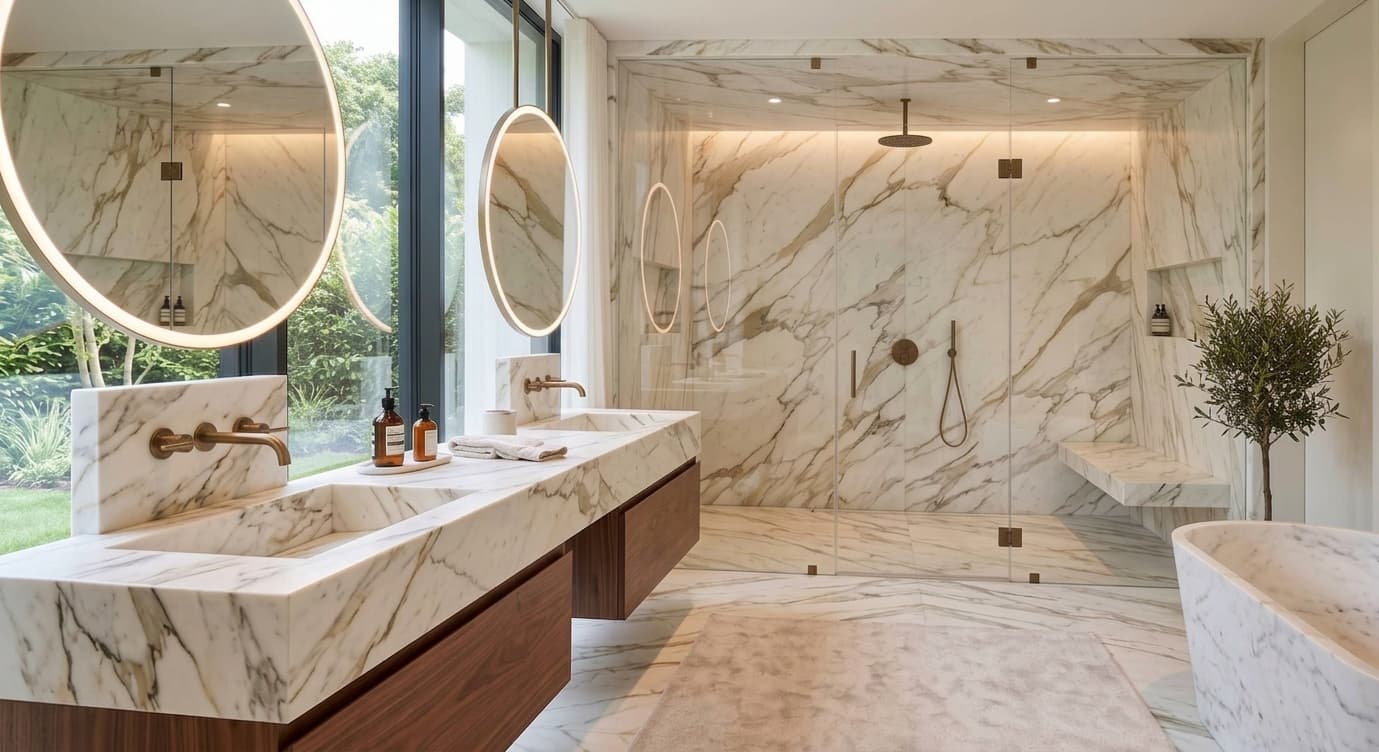
Kitchen islands and perimeter counters are the obvious place, especially where a hot pan or a squeezed lemon is a daily event. It works well as a full-height backsplash running up from the counter, and on bathroom vanity tops, where its resistance to etching from soaps and toiletries is a real advantage over marble. Its soft movement also suits fireplace surrounds and feature walls, where a pair of matched slabs can be laid out so the veining mirrors across the centre.
What drives the cost of a Taj Mahal countertop
We do not publish prices, because a countertop is quoted from a real layout rather than a rate card. Taj Mahal generally sits toward the upper end of the quartzite range, and the things that move a quote are worth knowing:
- Slab selection. A quiet, consistent slab with clean background is in more demand than a busier one, and pricing reflects it.
- Number of slabs. Matching veining across a seam, a waterfall end or a full-height backsplash all reserve extra stone.
- Fabrication time. A hard quartzite cuts more slowly than marble or engineered quartz, and edge profiles, sink cutouts and mitred edges all add shop time.
- Thickness and edge. A thicker look achieved with a mitred edge is more work than a simple eased edge on a standard slab.
If Taj Mahal is on your list, the most useful next step is a quote against your actual kitchen while the material choice is still open. We template, cut and install Taj Mahal quartzite in-house, from our North York shop across Toronto and the GTA; our kitchen countertops and islands page explains how a project runs from templating to installation.
FAQs
Common questions.
Is Taj Mahal quartzite or quartz better?
They suit different priorities. Taj Mahal quartzite is a natural stone: it handles heat far better, is the same material all the way through, and every slab is unique, but it should be tested and sealed when it absorbs. Engineered "Taj Mahal" quartz is manufactured with resin, never needs sealing and looks consistent from slab to slab, but it is more sensitive to heat and its pattern often does not carry through a shaped edge.
What are the downsides of Taj Mahal quartzite?
It is still a porous natural stone, so it needs testing and occasional sealing. Sharp edges can chip under a hard impact. It costs more to fabricate than softer stones because it cuts slowly. Its warm cream undertone can look yellow next to stark cool-white cabinets. And because it is so popular, softer stones are sometimes mis-sold under its name.
Does Taj Mahal quartzite stain or etch?
It does not etch from ordinary kitchen acids such as lemon, wine or vinegar, because it is silicate rather than calcite. It is one of the denser quartzites, so it resists staining well, but oil left on an unsealed surface can still darken it. Test it with a few drops of water and seal it when the stone darkens.
Is Taj Mahal quartzite expensive?
It generally sits toward the upper end of the quartzite range. The final cost depends on the slab you choose, how many slabs the layout needs, the edge profile, cutouts and any mitred or vein-matched details, so it is quoted per project rather than per square foot.
Is Taj Mahal quartzite going out of style?
Opinion is divided. The slabs most likely to date are the loud ones with heavy gold veining and strong contrast. A quiet slab chosen to suit your cabinetry and light is far more likely to age well.
What colour cabinets go with Taj Mahal quartzite?
Warm ones. Wood cabinetry, cream, taupe and soft greige paint, and creamy rather than stark whites. Give it contrast by choosing cabinets clearly lighter or darker than the stone.
Related Services
Where this applies.
Related Reading
More from the Journal.
Start Your Project
Ready to plan your own project?
Request an estimate or book an on-site laser measurement — our team will respond as soon as possible.