
Materials
Quartzite Countertops: What They Are, and What They Are Not
Quartzite is a natural stone, quartz is manufactured, and the two names cause more confusion than any other pair in the countertop trade. Here is what quartzite actually is, how it behaves, and how to tell it from what gets sold under its name.
Quartzite is the material most likely to be misunderstood in a countertop showroom, and almost all of the confusion comes down to a name. It sounds like quartz. It is sold alongside quartz. It is not quartz, and the two behave differently in a kitchen in ways that matter.
What quartzite actually is
Quartzite starts as sandstone. Heat and pressure deep in the earth push the sand grains together until they lose their original shape and fuse to their neighbours, forming a single dense rock rather than a collection of cemented grains. That fusing is the whole story: it is why quartzite is hard, why it does not behave like the sandstone it came from, and why quality varies with how thoroughly the process went.
Engineered quartz, confusingly, is made in a factory from crushed quartz bound with resin and pigment. Both materials are built around the same mineral. Only one of them is a rock.
Quartzite vs quartz: the differences that show up in a kitchen
- Origin — quartzite is quarried and cut, so every slab is unique; quartz is manufactured, so pattern and colour repeat predictably from slab to slab.
- Heat — quartzite handles heat far better. Engineered quartz contains resin, and sustained heat can scorch or discolour it.
- Porosity — quartz is non-porous and never needs sealing. Quartzite is a natural stone and its porosity varies, so some slabs benefit from sealing and some do not.
- Repair — quartzite is stone all the way through, so surface damage can often be honed or polished back. Quartz repairs depend on colour-matching a resin fill.
If the appeal of quartz is that it asks nothing of you, quartzite will not replicate that — it is a natural stone with a natural stone's habits. If the appeal is the look and toughness of real stone with better heat tolerance than quartz offers, quartzite is the material that does it.
Hardness, and what it is good for
Quartz the mineral sits at 7 on the Mohs hardness scale, which puts quartzite harder than glass and harder than a knife blade. In practice that means a quartzite counter is very difficult to scratch in normal kitchen use. It does not mean you should cut directly on it: a board protects the knives, which will lose that argument.
Hardness is not the same as toughness, either. A hard material can still chip if something heavy lands on an unsupported edge or a corner, which is why edge profiles and overhang support are worth planning rather than assuming.
Etching: the reason quartzite is not marble
This is where quartzite earns its place in a working kitchen. Marble, limestone and travertine are calcite-based, and ordinary kitchen acids — lemon, vinegar, wine, tomato — react with the stone and dull the polish, leaving a lighter matte mark. That is etching, and no sealer prevents it, because the acid attacks the mineral rather than soaking into it.
Quartzite is silicate rather than calcite. It will not etch from normal kitchen acids. For anyone who loves how marble looks but has been warned off it, this is usually the deciding fact.
Does quartzite need sealing?
Sometimes. Quartzite's porosity varies with how completely it was metamorphosed: tightly bonded varieties absorb very little, while more open ones benefit from a sealer. This is why a blanket answer is not much use, and why a fixed resealing schedule is not either.
Test it rather than guess. Put a small amount of water on the surface somewhere inconspicuous and leave it a few minutes. If the stone darkens where the water sat, it is absorbing and is ready for sealer. If it beads or the stone stays the same colour, the existing seal is still doing its job and another coat adds nothing.
The mislabelling problem, and how to avoid it
There is no such thing as soft quartzite. If a slab is being sold as quartzite and it is noticeably soft, scratches easily, or etches when a drop of lemon juice sits on it, what you are looking at is almost certainly mislabelled marble or dolomitic marble. This is a genuine and widespread problem in the trade, and it is the single biggest reason people end up disappointed by a stone they were told was bulletproof.
- Ask what the slab actually is and where it was quarried, not just what the display card calls it.
- Ask whether it etches. A supplier who knows their material will answer directly.
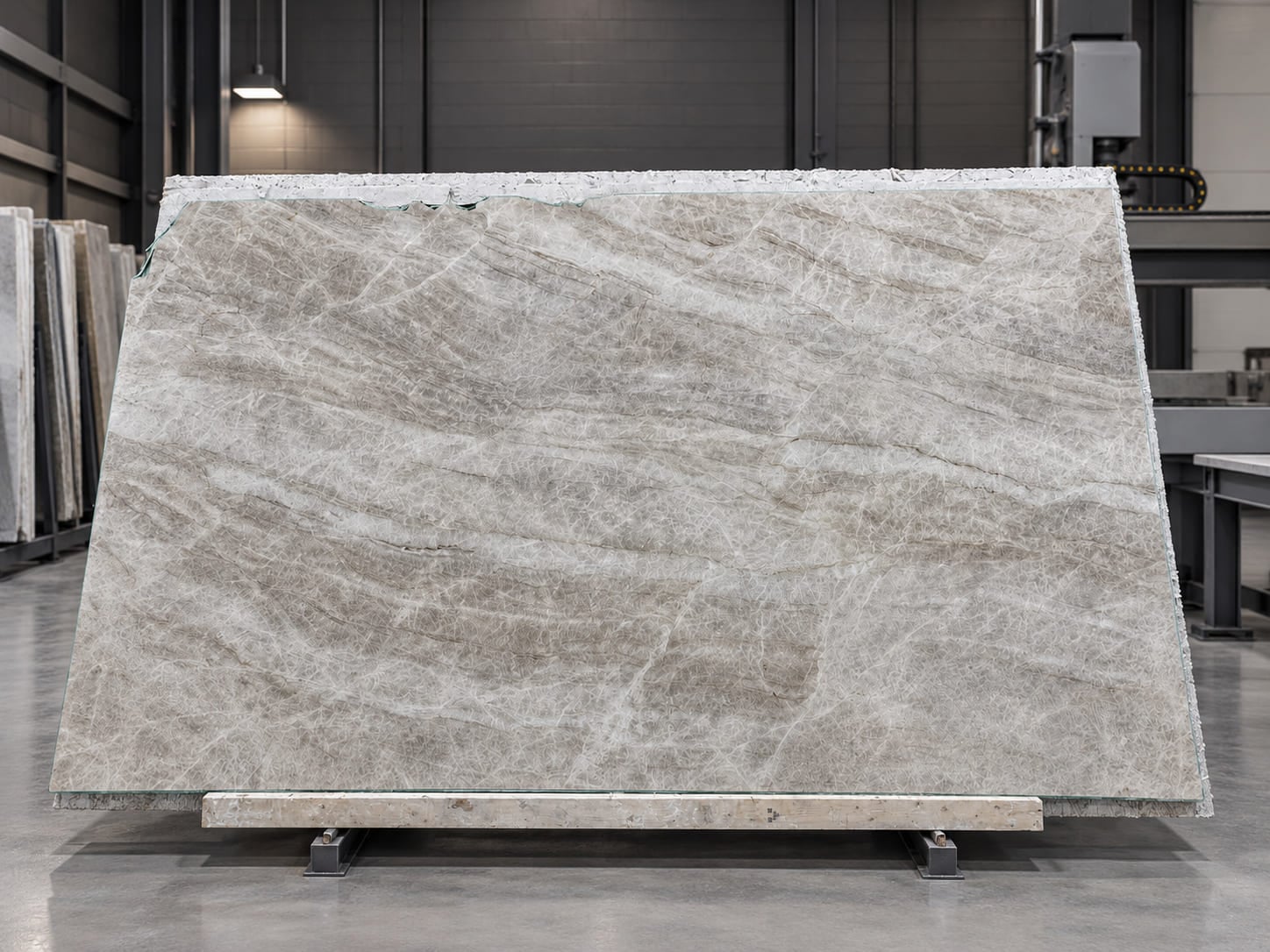
- View the actual slabs rather than a hand sample — quartzite's movement varies enormously across a single block.
Where quartzite makes the most sense
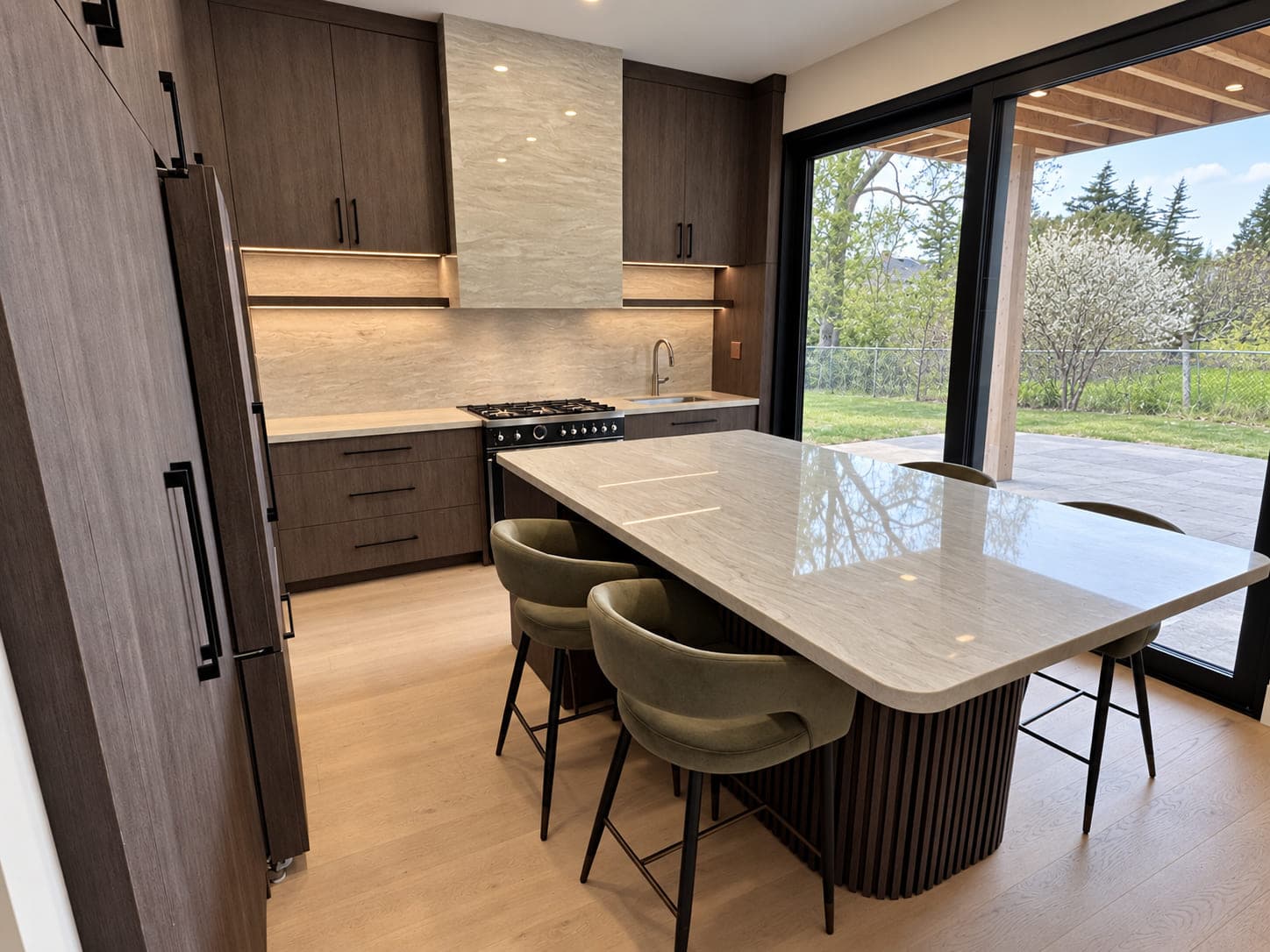
Quartzite suits a kitchen that gets used hard by someone who wants real stone: islands and counter runs that take heat near a range, surfaces where acids are unavoidable, and rooms where the one-of-a-kind movement of a natural slab is the point. It suits a full-height backsplash or a feature wall for the same reason — the pattern is the material's own, not a printed repeat.
Polished, honed or leathered
Finish changes how quartzite reads more than most people expect, and it is decided at fabrication rather than afterwards. A polished surface reflects light and pushes the colour and veining forward, which is what most showroom slabs are showing you. A honed finish is matte and quieter; it makes a busy stone calmer and hides fingerprints and water spots better, at the cost of some of the depth.
Leathered — a textured finish somewhere between the two — has become common on darker quartzites in particular, because it keeps some sheen without the mirror. It also disguises minor surface marks well. Whichever you choose, look at a sample in that finish rather than imagining it from a polished one: the same slab can look like two different stones.
Seams, and planning the slab
Any kitchen longer than a single slab needs a seam, and where it falls is a decision rather than an accident. Quartzite's strong natural movement generally hides a seam better than a uniform material does, because the eye is already following the veining, but the pattern has to be planned across the join for that to be true.
- Seams are normally kept out of the most-viewed sightlines and away from the wettest zones.
- A seam through a sink cutout is a weak point and is usually avoided.
- If the veining is dramatic, matching it across the seam has to be laid out on the actual slabs before cutting.
What drives the cost of a quartzite job
Quartzite spans a wide range, and the slab price is only part of it. The variables that actually move a quote are the grade and rarity of the material, how many slabs the layout needs, the edge profile, the number and complexity of cutouts, and whether the design asks for mitred edges or matched veining across joints — all of which are fabrication time rather than material.
Because those variables interact, a realistic figure only comes from a quote against your specific kitchen rather than a price per square foot seen somewhere. It is worth getting that early, while the material choice is still open.
It is a less obvious choice where budget is the primary constraint, or where somebody genuinely wants a surface that never needs looking at again. Engineered quartz is honest about being the lower-maintenance option, and there is nothing wrong with choosing it for that reason. If you are weighing quartzite against quartz or granite for a specific room, our kitchen countertops and islands page covers how each is templated, fabricated and installed, and the quartz vs. granite comparison sits alongside this one.
FAQs
Common questions.
Does quartzite need to be sealed?
Sometimes — it depends on the slab. Quartzite's porosity varies with how completely the stone was metamorphosed, so some varieties absorb very little and others benefit from sealing. Test with a few drops of water in an inconspicuous spot: if the stone darkens within a few minutes, it is ready for sealer.
Is quartzite harder than granite?
Quartzite is typically very hard — the quartz mineral sits at 7 on the Mohs scale, harder than glass or a knife blade. Granite is also hard and both resist scratching well in normal kitchen use, so hardness is rarely the deciding factor between them.
Does quartzite etch like marble?
No. Etching happens when acids react with calcite-based stones such as marble, limestone and travertine. Quartzite is silicate rather than calcite, so ordinary kitchen acids do not etch it.
How can I tell real quartzite from mislabelled marble?
There is no such thing as soft quartzite. If a slab scratches easily or dulls where a drop of lemon juice has sat, it is very likely mislabelled marble. Ask the supplier what the stone actually is and whether it etches.
Related Services
Where this applies.
Related Reading
More from the Journal.
Start Your Project
Ready to plan your own project?
Request an estimate or book an on-site laser measurement — our team will respond as soon as possible.