
Materials
Porcelain Countertops: Where They Win, and Where They Don't
Porcelain and sintered stone have become a genuine third option beside quartz and granite — non-porous, very heat and UV tolerant, and available in panels far larger than a natural block yields. Here is what they do well and what the trade-offs actually are.
Porcelain has moved from a tile material to a countertop material, and it now sits alongside quartz and granite as a serious option rather than a curiosity. It is worth understanding on its own terms, because it is neither a natural stone nor an engineered quartz and it does not behave quite like either.
What porcelain and sintered stone actually are
Both are made from mineral and clay content pressed and fired at very high temperature. The result is a dense, non-porous slab with no resin binder in it. "Sintered stone" generally refers to the same family of products made by compacting mineral powders under pressure and heat; the marketing names differ by manufacturer, the principle does not.
The absence of resin is the single most useful thing to know about them, because resin is what limits engineered quartz's heat tolerance. Porcelain was fired at temperatures far beyond anything a kitchen will produce.
Heat, UV and scratching
- Heat — very tolerant. A hot pan will not scorch or discolour a porcelain surface the way sustained heat can mark engineered quartz. A trivet is still sensible practice, not a necessity.
- UV — stable. Colour does not fade in strong sunlight, which is why porcelain is the usual answer for an outdoor kitchen or a run of counter under a large south-facing window.
- Scratching — highly resistant, though as with any hard surface a cutting board protects your knives more than it protects the counter.
- Staining — non-porous, so it does not absorb and never needs sealing.
Porcelain vs quartz: choosing between them
The two are closer to each other than either is to natural stone — both are manufactured, both are non-porous, both never need sealing. The differences that decide it are heat, light and thickness.
Porcelain wins on heat and UV, which makes it the better choice for outdoor kitchens, sunlit runs, and anywhere a hot pan is likely to land without ceremony. Quartz is thicker as standard and more forgiving to fabricate, and its pattern goes right through the slab. For an indoor kitchen out of direct sun, quartz remains the easier material and the difference in daily use is small.
Thickness, and what it means for the edge
Porcelain panels are often much thinner than a stone or quartz slab. That has two consequences worth knowing before you fall for a sample.
The first is support: a thin panel needs a properly prepared substrate beneath it, and that has to be planned with the cabinetmaker rather than discovered on installation day. The second is the edge. Getting a chunky, substantial-looking edge out of a thin panel means mitring — joining two pieces at 45 degrees so the edge reads far thicker than the material is. That is more fabrication work than a simple eased edge, and the mitre is a detail to discuss in advance.
Pattern through the body, or printed on the surface
This is the question most worth asking about a specific porcelain product, and the answer varies by manufacturer. On some products the decorative pattern is applied near the surface, so a cut edge or a mitred return may not carry the same veining through the thickness. On others the pattern runs through the body and behaves more like stone when cut.
Neither is wrong, but they suit different details. If the design depends on veining continuing around a waterfall edge or a mitred return, it is worth confirming which kind of product you are looking at before the slab is selected rather than after.
Where porcelain earns its place
- Outdoor kitchens and covered terraces, where UV stability and freeze-thaw behaviour matter more than anything else.
- Very large formats — panels are manufactured in sizes beyond what a natural block usually yields, which means fewer joints across a big elevation.
- Feature walls and fireplace surrounds, where the lighter weight simplifies the support problem compared with a full stone slab.
- Kitchens where a hot pan landing directly on the counter is a realistic daily event rather than a hypothetical.
The honest trade-offs
Porcelain is harder to fabricate than quartz and less forgiving of a mistake: a thin, very hard panel is more fragile in handling and transport than a thick slab of stone, and cutting it requires the right tooling and a steady approach. That is a fabricator's problem rather than yours, but it is a real reason the material is not simply better than everything else.
Sinks, cutouts and thin panels
A thinner panel changes how the sink is handled. An undermount sink still works, but the narrower edge gives less material to bond to and the cutout wants reinforcing, so this is planned rather than improvised on site. Some projects use the panel's own thinness deliberately, with a very fine visible edge around the bowl that is difficult to achieve in thicker materials.
The practical point is the same as everywhere else in a stone project: the sink and tap need to be on site or fully specified before templating, because the cutout is made to the actual fixture rather than to a catalogue dimension.
Full-height backsplashes and large elevations
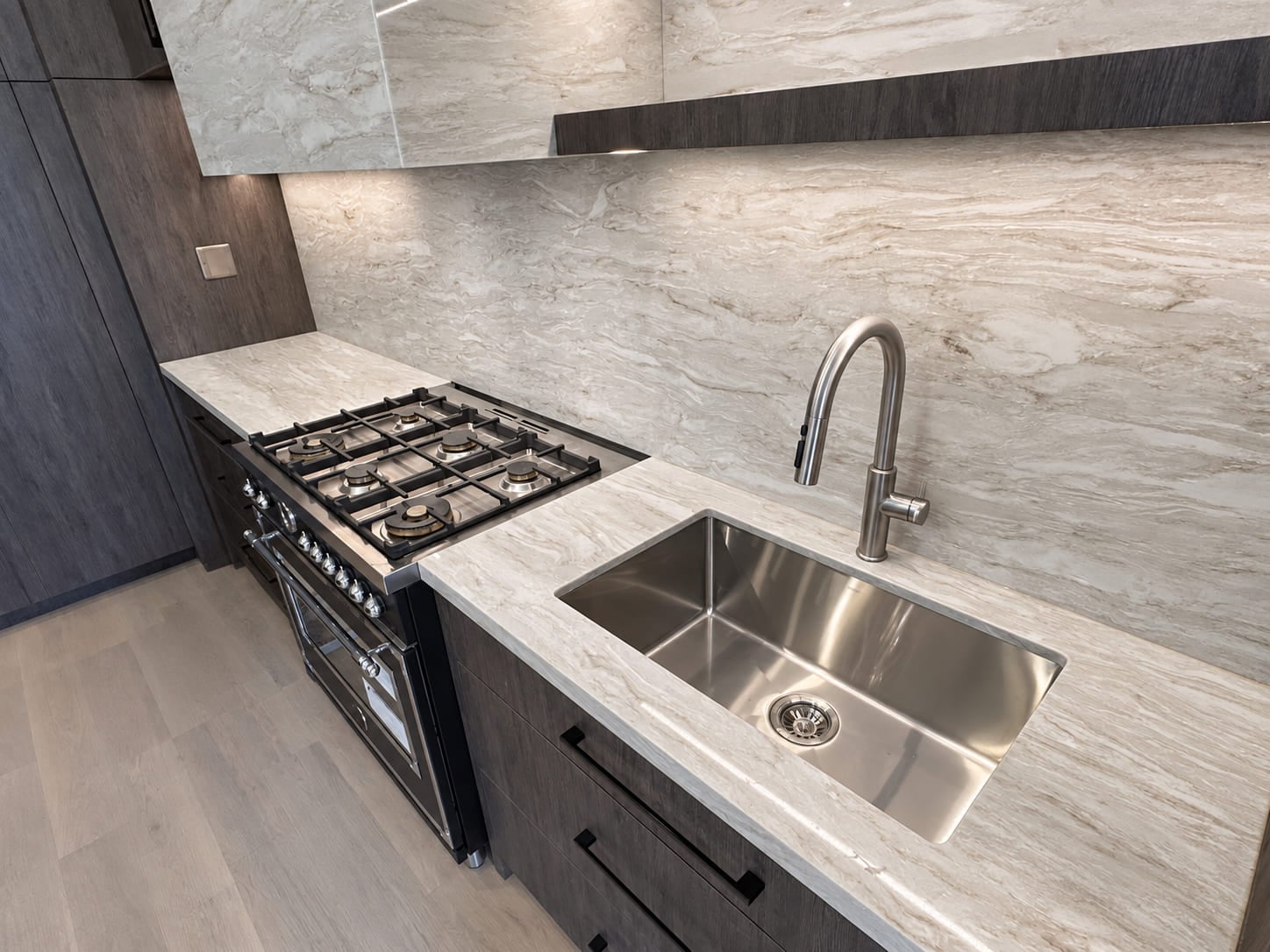
This is where large-format porcelain is at its most persuasive. Because panels come in sizes beyond what a natural block usually yields, a full-height backsplash or a whole wall can often be done with fewer joints — sometimes none at all across a run where stone would need two or three. Fewer joints in a big, flat, well-lit elevation is a real visual gain.
The lighter weight helps here too: a wall of thin porcelain puts far less load on the substrate than an equivalent area of stone slab, which simplifies fixing and makes some installations possible that would otherwise need structural work.
Everyday care
Porcelain is the least demanding surface in this whole comparison. It is non-porous, so nothing soaks in and there is no sealer to maintain. Warm water and a mild cleaner handle daily use, and because there is no resin and no calcite it is not vulnerable to the two things that catch people out elsewhere — heat marking engineered quartz, and acids etching marble.
- No sealing, ever.
- Acids, wine, oil and citrus are not a problem on the surface itself.
- Use a board for cutting — to protect the knives rather than the counter.
- Avoid dropping heavy objects onto an edge or an unsupported corner, which is where any hard, thin material is most vulnerable.
So which material should you actually choose?
If heat and sunlight are the problem you are solving — an outdoor kitchen, a sunlit run, a cook who puts pans down without thinking — porcelain answers it better than quartz does. If you want a very large elevation with as few joints as possible, it answers that too.
If the kitchen is indoors and out of direct sun, engineered quartz is the easier material and you will not notice the difference day to day. And if what you want is the one-off character of a real slab, neither is the answer — that is natural stone's job, and no printed pattern substitutes for it.
It is also a manufactured pattern. If what you want is the one-off geological record of a particular block — the thing a bookmatched natural slab gives you — porcelain is not the material for that job, however convincing the print. If you are weighing porcelain against quartz or natural stone for a specific room, our kitchen countertops and islands page covers how each is templated and installed, and full-slab feature walls covers the large-format side.
FAQs
Common questions.
Do porcelain countertops need sealing?
No. Porcelain is fired to a non-porous state, so it does not absorb liquids and there is no sealer to apply or reapply.
Can porcelain countertops chip?
Yes, like any hard surface. Porcelain is very resistant to scratching, but a hard impact on an edge or an unsupported corner can chip it, which is part of why edge detailing and substrate preparation are planned rather than improvised.
Can you put a hot pan on porcelain?
Porcelain handles heat far better than engineered quartz, which contains a resin binder that sustained heat can mark. A trivet remains good practice for any surface, but heat is not porcelain's weak point.
Is porcelain suitable for an outdoor kitchen?
It is one of the better options. Porcelain is non-porous and UV-stable, so colour does not fade in strong sunlight the way some materials can. Substrate and support still need planning for outdoor use.
Related Services
Where this applies.
Related Reading
More from the Journal.
Start Your Project
Ready to plan your own project?
Request an estimate or book an on-site laser measurement — our team will respond as soon as possible.