
Design
Waterfall Countertops: What the Mitre Decides
A waterfall edge looks like one uninterrupted piece of stone turning a corner. It is two pieces, joined at the one place in the room everybody looks. Here is what actually determines whether it reads as expensive or as a mistake — and the drawback nobody mentions until you live with it.
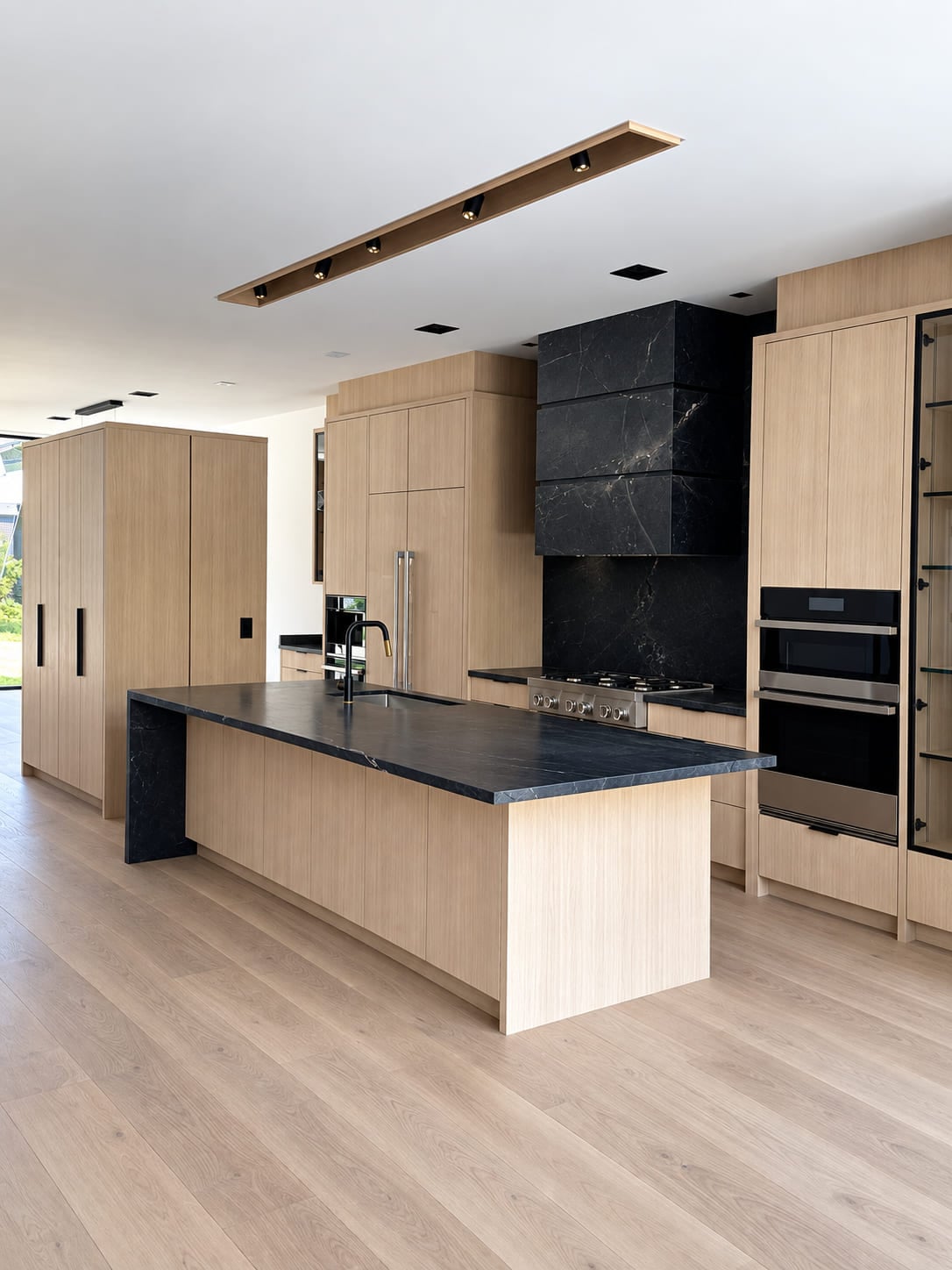
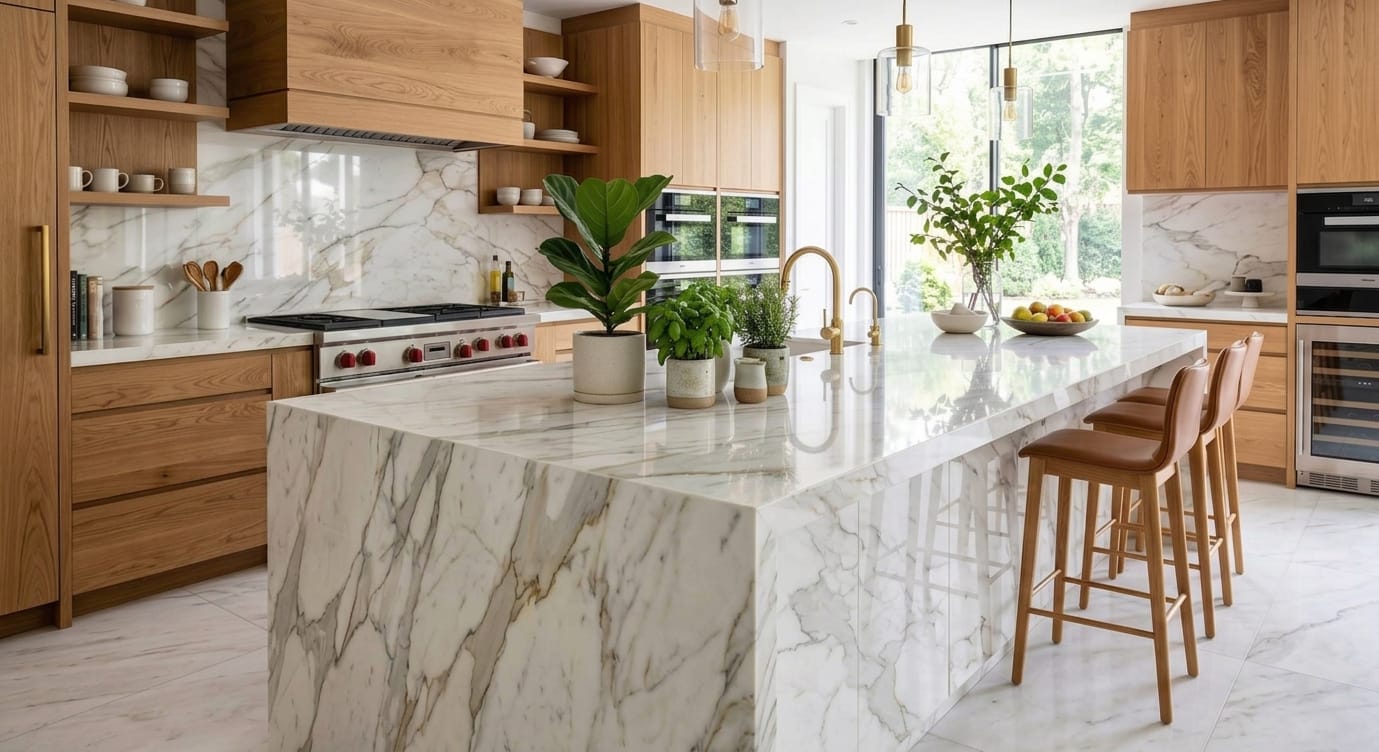
A waterfall edge is the detail most often described as simple by people who have never had one made. The stone runs along the top of an island, turns ninety degrees at the end, and carries on down to the floor. It reads as a single uninterrupted piece. It is not. It is two pieces meeting at a corner, and that corner sits at roughly eye level in the middle of the room, which is the least forgiving place in a kitchen to put a joint.
Almost everything that separates a waterfall that looks expensive from one that looks like a mistake is decided before any stone is cut.
What a waterfall countertop actually is
The countertop continues past the end of the cabinet and drops vertically to the floor, instead of stopping at an edge with the cabinet side visible beneath it. It is most common on a kitchen island or peninsula, and occasionally on a vanity.
It is worth being precise about the words, because three different things get called the same thing. An overhang is the top projecting past the cabinet to make room for seating. An apron or skirt is a deeper front edge built up to look thicker. A waterfall is the surface turning the corner and running to the floor. Only the last one needs a mitred joint, and only the last one has a material cost that lands well above what people expect.
A waterfall is an edge treatment, not a material. It can be done in quartz, granite, marble, quartzite or porcelain — but as you will see, the material decides how hard it is.
The mitre is the whole job
At the corner, two pieces are each cut at forty-five degrees and joined to form a right angle. The alternative — butting the vertical panel under the horizontal top — leaves the cut thickness of the slab showing as a band along the top edge. On a polished stone that band reads as a different material, because in effect it is: the unpolished interior of the slab rather than its finished face. A mitre hides it. The two polished faces meet and the corner looks solid, as though the piece were carved from a block.
This is where tolerance stops being an abstraction. The Natural Stone Institute now gathers dimension-stone tolerances into a dedicated chapter of its Dimension Stone Design Manual (opens in a new tab), on the straightforward principle that acceptable variation has to be written down before anyone can be held to it. A mitre is unforgiving of variation in a way a flat run of counter is not: a fraction out and the joint opens into a visible dark line, or closes unevenly and leaves a lip you can feel with a fingertip. Nobody measures it. Everybody notices it.
It is also the reason the joint gets cut on a machine rather than by hand. Every mitred edge we cut is profiled on the same 5-axis CNC used for the rest of the kitchen, so the angle is repeatable across both halves of the corner rather than dressed to fit on site. Writing in The Kitchn, one homeowner found that not every fabricator was willing or able to take the work on at all — a mitre risks chipping the fine-cut corner or cracking the seam, during fabrication and afterwards.
Vein matching, and why you buy the slab twice over
For the veining to continue around the corner, the vertical panel has to be cut from the stone immediately adjacent to where the horizontal piece ends. Not from elsewhere on the slab, and not from a different slab of the same name. The pattern has to carry on from where it left off, the way a folded sheet of paper keeps its printing across the crease.
That reserves material you then cannot use anywhere else. The panel is roughly the height of the island by its depth, in stone that has to be kept clean and uninterrupted, which is why a waterfall consumes far more slab than its finished square footage suggests. On heavily figured natural stone it can mean sourcing a larger slab, or a matched pair, purely so the corner works.
The same homeowner account describes exactly this trade being forced: to get a slab large enough for continuous veining, she accepted a leathered finish instead of the polished one she had originally wanted. That is the real shape of the decision. It is rarely whether you can afford the extra stone; it is which of your other preferences you are willing to give up to get it.
Engineered quartz makes this easier, because pattern is manufactured rather than geological — though directional patterns still need laying out deliberately. Natural stone makes it harder and more rewarding. If continuity across the corner is the whole point of the design, it belongs in the conversation at slab selection, not at templating. Our guide to choosing a kitchen countertop material covers how the material choice narrows everything that follows.
One end, or both?
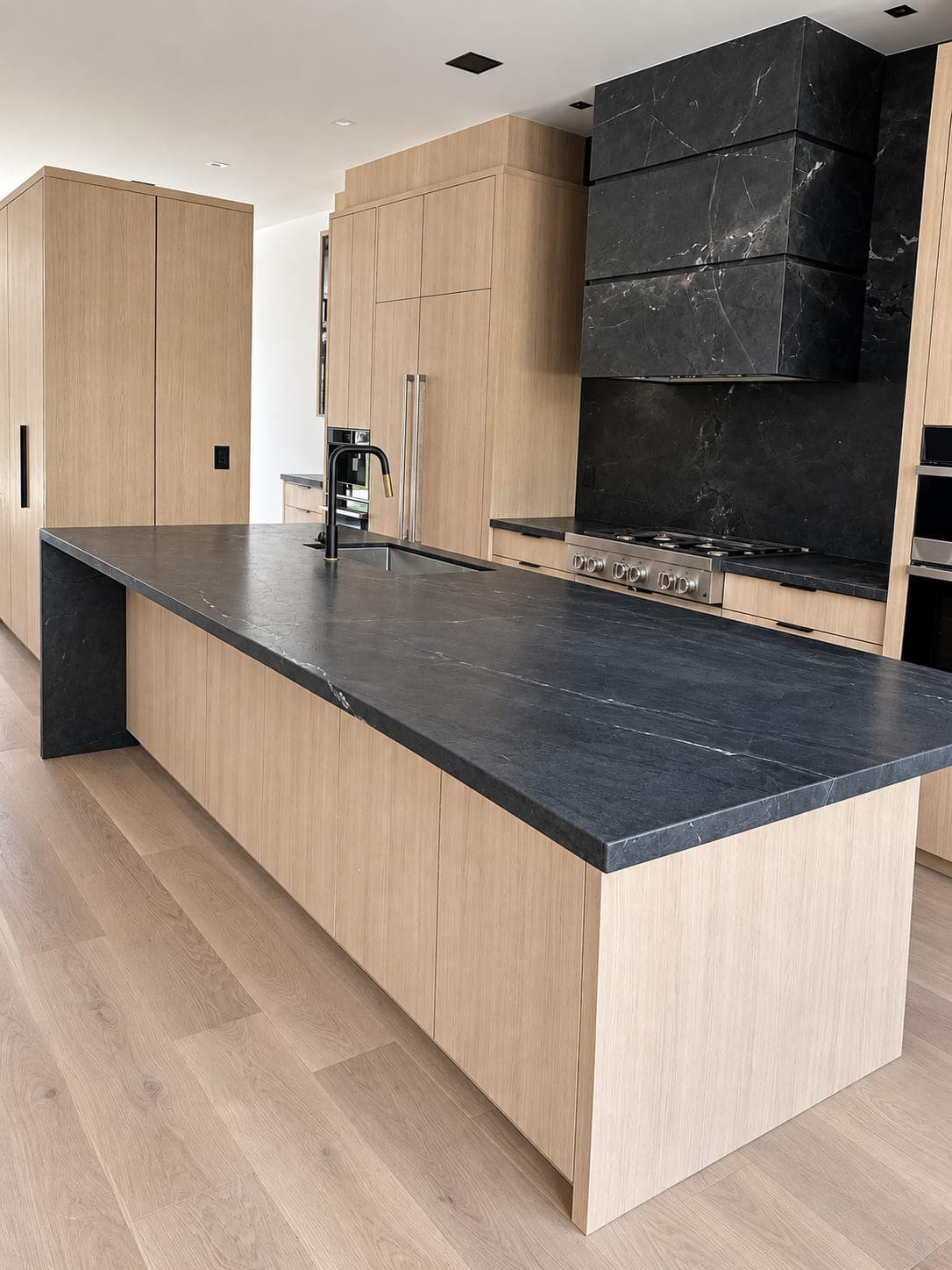
A double waterfall is symmetrical and monumental, and it roughly doubles the panel material. A single waterfall anchors one end of the island and leaves the other free — which matters more than it sounds, because a waterfall panel and seating are mutually exclusive at the same end. The panel occupies exactly the space a pair of knees needs.
So the question is settled by the plan, not by taste. If the island seats four along one side, a waterfall at the open end usually works. If seating wraps the end, it does not. Deciding this after the cabinets are set is how people end up with a beautiful panel and nowhere to sit.
What it adds to the cost
We do not publish prices, because a countertop is quoted from a real layout rather than a rate card. But it is useful to know what a waterfall is actually charging you for, because the drivers are not mysterious:
- Material. Two vertical panels are additional square footage on top of the horizontal surface, cut from reserved, uninterrupted stone.
- Yield. Holding back the adjacent stone for vein continuity means the rest of the slab is less usable, so effective waste rises even though nothing is wasted.
- Fabrication. The mitre is precision work on a machine, then dry-fitted and bonded, then the joint is dressed and polished so it disappears.
- Handling. A full-height panel is heavy, fragile at the mitred edge, and needs more people and more care to get into a house and set plumb.
For scale rather than as a quote: the homeowner writing in The Kitchn reported the additional labour on her waterfall came to nearly a thousand dollars on top of the stone. Your project will differ — that is one person's kitchen in one market — but it is an honest order of magnitude for the labour component alone, and more useful than a vague warning that waterfalls are expensive.
The drawback nobody mentions until you live with it
A waterfall has no lip. On an ordinary counter the top projects slightly past the cabinet, so crumbs swept toward the edge drop into your hand or into a bin you have pulled up to it. On a waterfall edge the surface turns and goes straight down, flush to the floor, so anything you sweep off that end lands on the floor. This is the single complaint that recurs in owners' accounts, and it is the one raised in The Kitchn piece above.
Related, and smaller: the corner where the panel meets the floor collects dust and needs a deliberate wipe, and a sharp mitred corner at hip height in a walkway is worth easing very slightly rather than leaving knife-crisp. Neither is a reason to avoid a waterfall. Both are worth knowing before rather than after.
When a waterfall is the wrong call
- The end of the island is the seating end, and you want to actually sit there.
- The kitchen is tight enough that a panel running to the floor narrows the walkway past the island.
- The stone is so heavily and irregularly figured that convincing continuity around the corner is not achievable, and an approximate match will read as an error rather than as nature.
- The budget is finite and the same money would buy a better material, a thicker top, or a full-height backsplash — any of which may do more for the room.
It is a detail worth doing well or not at all. A waterfall executed with an open joint or a broken vein draws attention to itself for the wrong reason, and it is the most expensive place in the kitchen to be looked at closely.
What to ask before you commit
- 01Is the mitre cut in your own shop, or subcontracted? Ask who owns the result if the corner chips.
- 02Can I see the slab layout before anything is cut, with the panel marked on it?
- 03Is the veining continuous around the corner, or approximately matched? Both are legitimate; only one is what most people picture.
- 04Which end waterfalls, and has that been checked against the seating plan and the walkway?
- 05How is the bottom of the panel detailed where it meets the floor?
Every one of those is answerable at templating, which is the point at which a waterfall stops being an idea and becomes a set of measurements. If you are planning an island and want to know whether the detail is worth it in your particular kitchen, that conversation is the kitchen countertop and island work we do — and it is a great deal cheaper to have before the slab is cut than after.
FAQs
Common questions.
What is a waterfall countertop?
A countertop where the surface continues past the end of the cabinet and drops vertically to the floor, instead of stopping at an edge. It is most common on a kitchen island or peninsula. The corner is formed by mitring two pieces together so the polished faces meet and the slab's cut thickness never shows.
Are waterfall countertops still in style?
They are still widely specified, and opinion is genuinely divided — some designers treat them as a dated trend, others as a permanent part of the modern island vocabulary. A more useful question is whether the detail suits your island, because a waterfall is expensive to undo. Where the veining carries cleanly around the corner and the end is not the seating end, it tends to age well.
How much more does a waterfall edge cost?
It depends on the layout and the material, so it is quoted per project rather than as a rate. The cost comes from four things: the extra square footage of the vertical panels, the reserved adjacent stone needed for vein continuity, the precision mitre work, and the handling of large, fragile panels. One homeowner writing in The Kitchn reported nearly a thousand dollars in additional labour alone on her project.
Does the veining have to line up around the corner?
It does not have to, but continuous veining is what most people are picturing when they ask for a waterfall. Achieving it means cutting the vertical panel from the stone immediately adjacent to where the horizontal piece ends, which reserves material and can mean sourcing a larger slab. An approximate match costs less and is a legitimate choice — it should just be a choice you made rather than one you discover on installation day.
Can a waterfall be added to an existing island?
Only by replacing the countertop. The mitre is cut into the horizontal piece itself, so the existing top would have to come off and be refabricated or remade. If a waterfall is a possibility later, it is far cheaper to decide on it now.
Related Services
Where this applies.
Related Reading
More from the Journal.
Start Your Project
Ready to plan your own project?
Request an estimate or book an on-site laser measurement — our team will respond as soon as possible.